
Takanori Takebe is on a mission to find out if people can breathe through their butts.
This is not the physician and scientist’s usual line of research. He spends most of his time trying to grow lab-made livers to treat organ failure. But Takebe’s side quest to explore backside breathing began several years ago when his father caught pneumonia.

At the time, Takebe’s dad had to be hooked up to a ventilator. This involved snaking a tube down his throat so that a machine could push air into his lungs. “I was really shocked by how invasive it is,” says Takebe, who works at Cincinnati Children’s Hospital Medical Center in Ohio. He also works at the University of Osaka in Japan.
Takebe worried about how the ventilator might affect his dad. Doctors had already removed part of his dad’s left lung due to a past infection. Takebe also was concerned about his father’s lack of other options if the ventilator didn’t get him enough oxygen. That got the scientist curious: Was there was any way to get oxygen into the body without using the lungs?
Inspiration struck when a student brought a book into Takebe’s lab. The book described how some animals get oxygen through their skin or guts. Freshwater fish called loaches offer one example. They can swallow air and absorb oxygen through their intestines. It’s a trick that helps them survive when their gills can’t pull enough oxygen from the water.
Takebe is an expert in the branch of medicine that deals with the digestive system. So he knew that the human intestinal tract is rich in blood vessels. That’s why treatments called enemas — which send liquid up a patient’s bottom — can get medicine into the bloodstream. And it made Takebe suspect that oxygen could pass from the intestines into the bloodstream, too.
Up-the-bum oxygen
Takebe’s team devised an enemalike treatment. It sends a liquid called perfluorodecalin (Per-floor-oh-DEK-uh-lin) up the rectum. This liquid can be loaded up with lots of oxygen. As it releases that oxygen into the body, space opens up within the liquid’s chemical structure. The liquid can then absorb “exhaled” carbon dioxide.
The scientists first tested this in mice and pigs. The super-oxygen-rich liquid did help the animals survive low-oxygen conditions. Pigs got 400-milliliter doses. (That’s slightly more liquid than a 12-ounce can of soda.) Each dose boosted pigs’ oxygen levels for about 19 minutes.
Takebe’s team published those findings in 2021. Later pig tests showed the technique could improve animals’ oxygen levels for up to half an hour.
During these experiments, Takebe vividly recalls seeing samples of the pigs’ blood change color. It shifted from a muddy, low-oxygen hue to a brighter, oxygen-rich red. “That was my aha moment,” he says. It’s when he realized this wild idea might actually work.
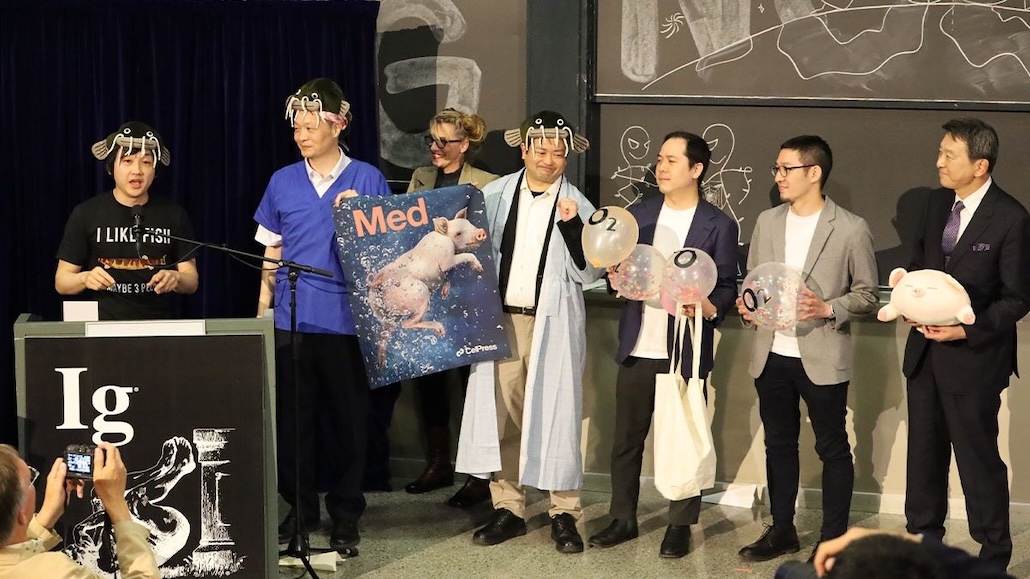
In 2024, the research won an Ig Nobel Prize — a cheeky award for science that makes people laugh, then think. “Thank you so much for believing in the potential of [the] anus,” Takebe said at the awards ceremony.
Gut check
Now, Takebe’s group has tested the safety of butt breathing in people.
Twenty-seven healthy men in Japan volunteered to take a dose of perfluorodecalin up the anus. They were asked to hold it there for an hour. The liquid wasn’t loaded with oxygen as it would be for a real treatment. The scientists just wanted to see if people could hold this liquid in their guts without it harming them.
Volunteers got different amounts of the liquid. The smallest dose was a squirt of 25 milliliters (about 5 teaspoons). The biggest dose was a whopping 1.5 liters (about 1.5 quarts). That’s the most currently allowed for other medical procedures that send liquid up the bum.
Four of the six men in the 1.5-liter group had to stop receiving liquid early. It hurt their stomachs too much. But most of those who got up to 1 liter fared pretty well. Their worst complaints were bloating and mild tummy pain.
Takebe’s team shared its findings December 12, 2025, in Med. The research was funded by EVA Therapeutics, a company Takebe cofounded to pursue butt breathing.
The new results hint that this treatment could be safe for people. Still, that doesn’t mean it’s effective. Future studies will have to show whether this treatment actually gets oxygen into people’s bloodstream.
Safe, but sensible?
Doctors and scientists have mixed reactions to this research, Takebe says.
One serious skeptic is John Laffey. He’s a doctor and scientist who specializes in lung failure. He works at the University of Galway in Ireland.
Researchers should focus on improving treatments that support the lungs, Laffey says. They shouldn’t be trying to make other body parts do the lungs’ job. “The lung, even an injured lung, will always exchange gas way better than any other organ,” Laffey says. “That’s what it’s designed for.”
And even if people can get oxygen through the intestines, that wouldn’t make it practical, Laffey adds. “A liter of perfluorodecalin carries 500 milliliters of oxygen,” he says. “We use 250 milliliters per minute. … It’s just very hard to see how this would work.” At the very least, sustained oxygen support would require a lot of enemas, over and over.
Kevin Gibbs is more intrigued by the treatment. He’s a critical-care lung doctor at Wake Forest University School of Medicine in Winston-Salem, N.C.
Do you have a science question? We can help!
Submit your question here, and we might answer it an upcoming issue of Science News Explores
“It definitely raised my eyebrows,” Gibbs says of the butt-breathing idea. “As someone who treats a lot of people who have low oxygen levels, I tend to think of myself as an above-the-waist doctor.” But sending oxygen in the back entrance — if it’s shown to work — could be useful in a few cases, he thinks.
One example is when doctors need to put a tube down someone’s throat to hook them up to a ventilator. The process takes mere minutes. Yet in that time, patients can suffer dangerously low oxygen levels, Gibbs points out. If sending oxygen up the anus works, it might sustain patients for the short time it takes to get them on life support. “That would be huge,” he says.
Takebe also imagines intestinal oxygen as an add-on to other types of breathing support. It could also be a short-term solution when other treatments aren’t available. “Maybe we can apply this in emergency situations,” he says. For instance, when someone is on the way to the hospital. Or when they’re being transferred from one hospital to another. But that future would still be many years and clinical trials away.
In the meantime, how does Takebe’s father feel about butt breathing as a way to help patients like him? “Dad is pleased,” Takebe says. “He’s always offering to be our experimental subject.” That would of course be a conflict of interest, Takebe adds. But he appreciates his dad’s support.