Event horizon (noun, “Ee-VENT hur-AYE-zon”)
An event horizon is a boundary surrounding a black hole. Beyond this boundary, nothing — not matter, energy or any kind of information — can escape.
A black hole is an ultradense object with extremely strong gravity, which draws in matter and energy around it. The speed that something needs to escape an object’s gravity is called the escape velocity. (Something has to blast off Earth at about 11 kilometers per second or 7 miles per second, for instance, to escape into space.) But at a certain point around a black hole, matter or energy would have to travel faster than the speed of light to escape. And this is impossible. That point of no return is the event horizon.
An event horizon would never be directly visible to us. That’s because light would have to leave it in order to reach our eyes or be captured by a telescope. But the shadowy outline of this boundary has been captured in images.
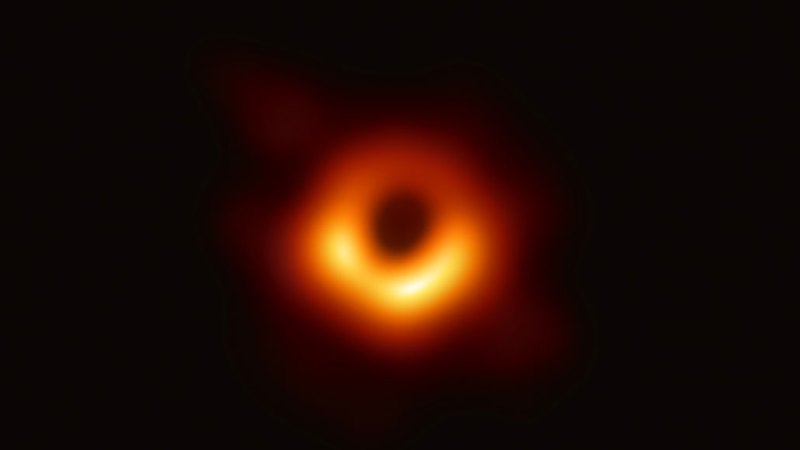
In April 2019, the Event Horizon Telescope released the first image of a black hole. It revealed the black hole at the center of the Messier 87 galaxy. This galaxy is about 55 million light-years from Earth. In 2022, scientists shared the first image of the black hole at the center of our own galaxy.
An image of a black hole looks like a black sphere encircled by a ring of light. The ring of light is the bright disk of gas orbiting the black hole. The black, pupil-like center shows the region where light is trapped and cannot escape. This region is called the “black hole shadow.” The event horizon lies within that shadow. Light bends around the black hole in such a way that the dark region appears at least twice the size of the actual event horizon.
In a sentence
In 2019, the first image of a black hole revealed a shadowy region, within which lies the mysterious event horizon.