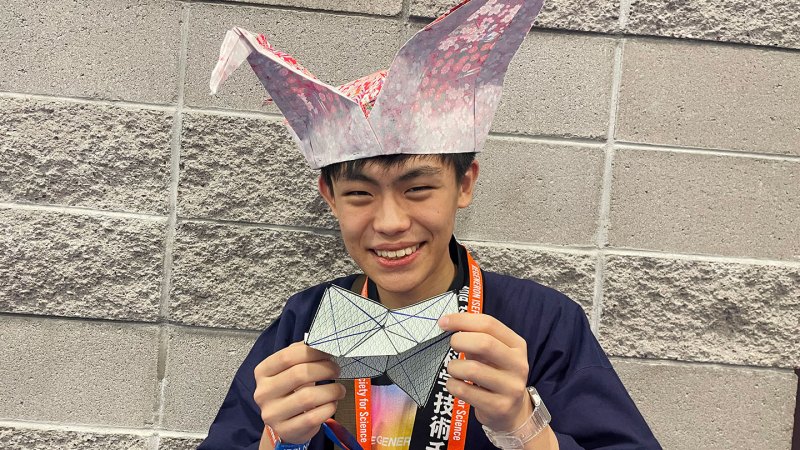
Phoenix, Ariz. — Origami is the Japanese art of paper-folding. But Mother Nature has developed her own examples of this art, says Hikaru Kuribayashi. To demonstrate, the 17-year-old picks up his model of a ladybug wing and opens it flat. This teen has just found a new way to model every possible motion such folded structures can make.
For this discovery, Hikaru received the George D. Yancopoulos Innovator Award and $100,000 here on May 15. A student at Sapporo Kaisei Secondary School in Japan, Hikaru was a finalist in the 2026 Regeneron International Science and Engineering Fair, or ISEF. An annual competition since 1950, ISEF was created by and is still run by the Society for Science (which also publishes this magazine). Hikaru’s research also took first place in the physics category, which earned him another $6,000.
The teen’s new understanding of origami can let engineers copy many of nature’s designs. Imagine a leaf unfolding. Those leaves, Hikaru says, represent a famous origami pattern called Miura-ori. This same pattern shows up in architecture and engineering.
Currently, engineers use a math-heavy approach to model shapes and their movements, the teen says. They start by identifying all the shapes a structure could take and then calculate every arc and trajectory its moving parts could take.
That “method only traces one motion passed at a time,” Hikaru explains. It doesn’t include all possible motions. To show what he means, the teen unfolds the ladybug wing again. This time, he twists it back and forth as he opens it. This temporarily warps the material.
Current modeling techniques cannot account for all such warps in soft or hyper-flexible real-world materials, he says.
But Hikaru’s “probability-based” approach can.
He points to the creases and dotted indentations left behind by the folds of the insect-wing model. With just these dots and lines, the teen says he can model every possible motion possible this wing can make. And, he adds, he can apply the same technique to “analyzing the motion of birds or any mechanism … that can be expressed as dots and lines.”
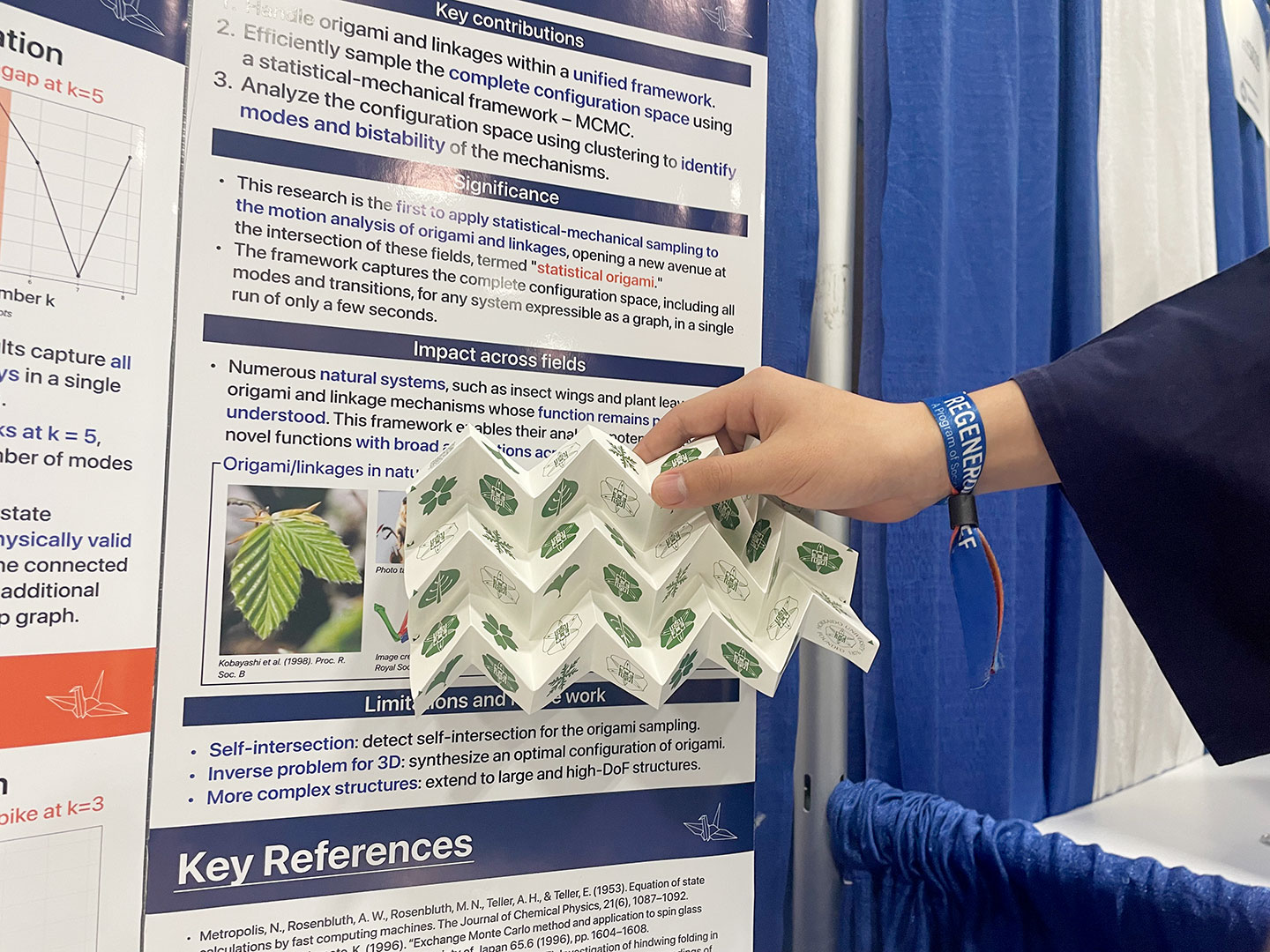
Why might anyone need Hikaru’s new tool? Imagine looking at a leaf with very obvious folds. Someone might wonder: Couldn’t you just copy those creases?
Not easily, Hikaru says. Even something as relatively simple as a leaf has a lot going on. Unfold an actual ladybug wing and you’ll find it’s full of creases. Its numerous convolutions make many types of movement possible.
Using his innovative approach, the teen says, could help engineers design powerful new nature-inspired tech.
Do you have a science question? We can help!
Submit your question here, and we might answer it an upcoming issue of Science News Explores
Other top winners
Lakshmi Agrawal, 18, of Bellevue, Wash., and Nikola Veselinov, 17, of Sofia, Bulgaria, each took home Regeneron Young Scientist Awards and $75,000. These teens also placed first in their divisions at the fair, earning each another $6,000.
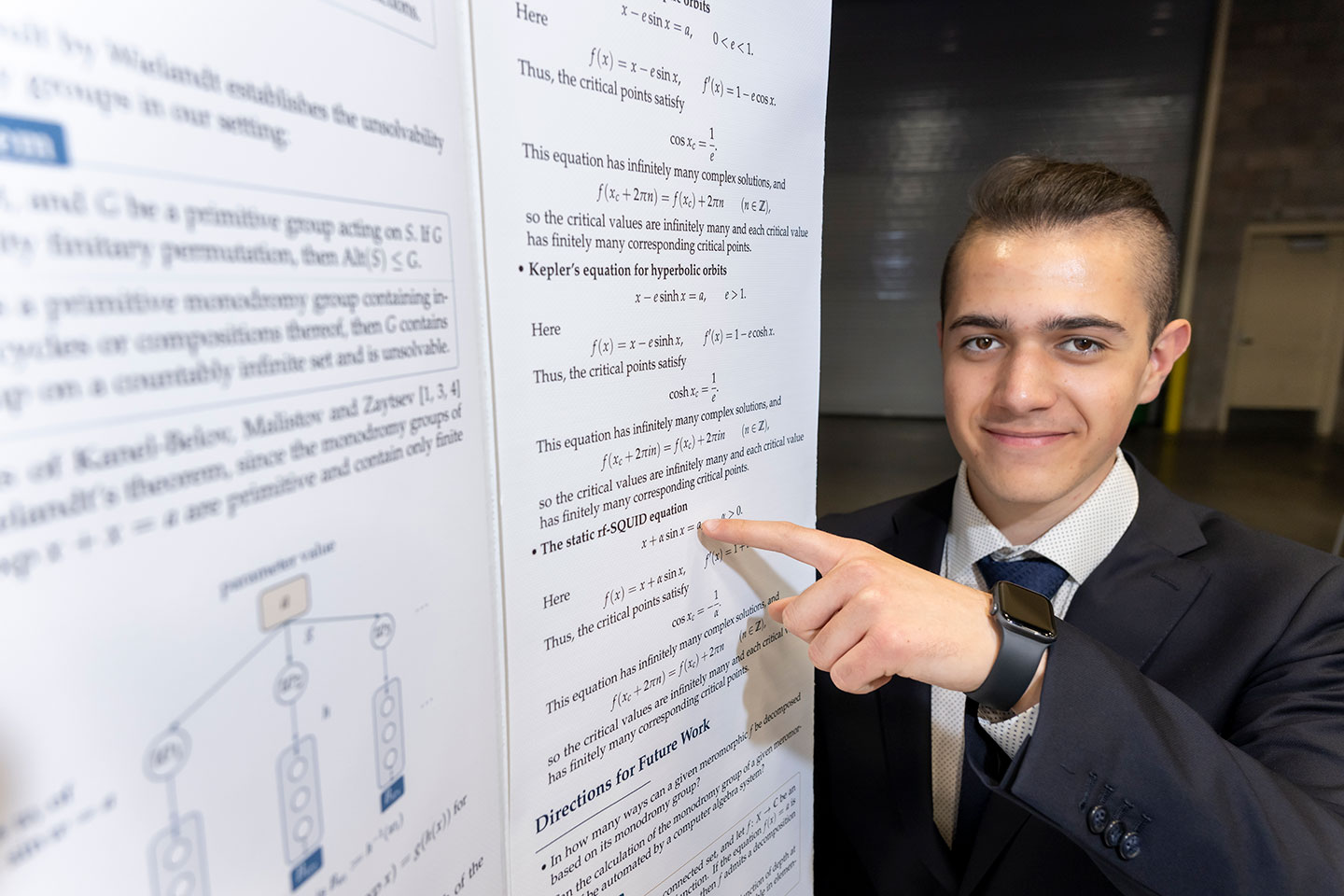
Nikola came up with a new math theorem. That’s a kind of statement in math that is proven — through logic — to be true. Once proven, a theorem does not change. Nikola’s theorem outlines certain conditions that would make an equation unsolvable using elementary math functions.
Lakshmi invented a sponge that sops up 6PPD-quinone from river water. This chemical is toxic to fish. Around Puget Sound in Washington state, it kills many adult salmon before they can lay their eggs. This poison may also pose a risk to people, according to the Washington State Department of Health.
The pollutant comes from vehicle tires. As tires wear down, they release tiny particles of rubber that contain 6PPD. That chemical can then react with ozone and other air pollutants to produce the quinone form. Each time it rains, runoff will carry 6PPD-quinone into local waters.
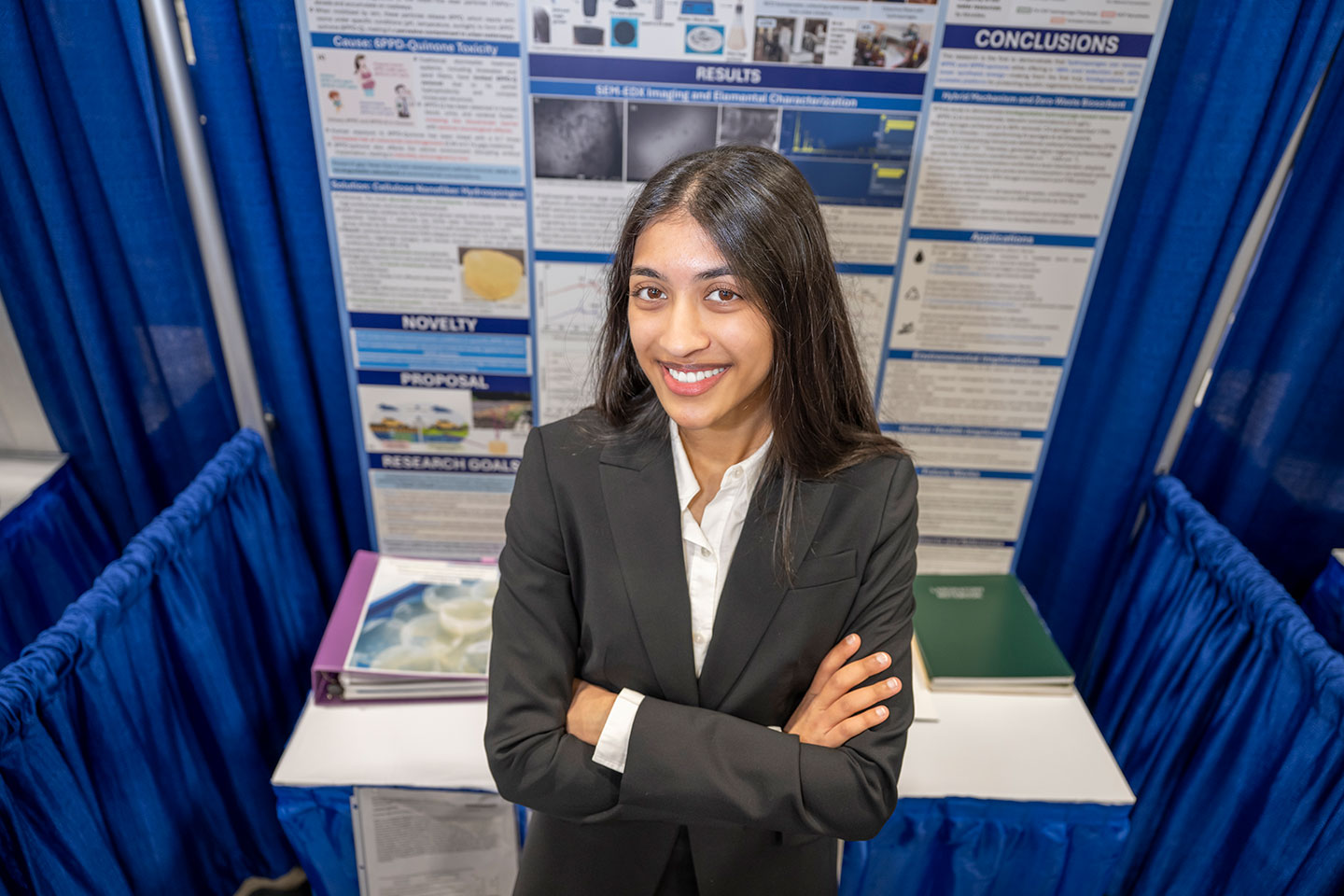
Lakshmi created biodegradable nanocellulose sponges to clean up the rivers. Her sponges remove up to 80 percent of the 6PPD-quinone, she reports. Using these sponges would cost 98 percent less than alternative cleanup techniques. She hopes her work will provide a quick, inexpensive way to clean the rivers and save wildlife.
Lakshmi, Nikola and Hikaru were among 1,725 finalists — from 65 nations or territories — participating in this year’s 2026 Regeneron ISEF. A host of other winners took home prizes that this year totaled nearly $7 million.